Tuesday, May 2, 2017

Fiesta at the FSC

Text and photos by Emily Rempel

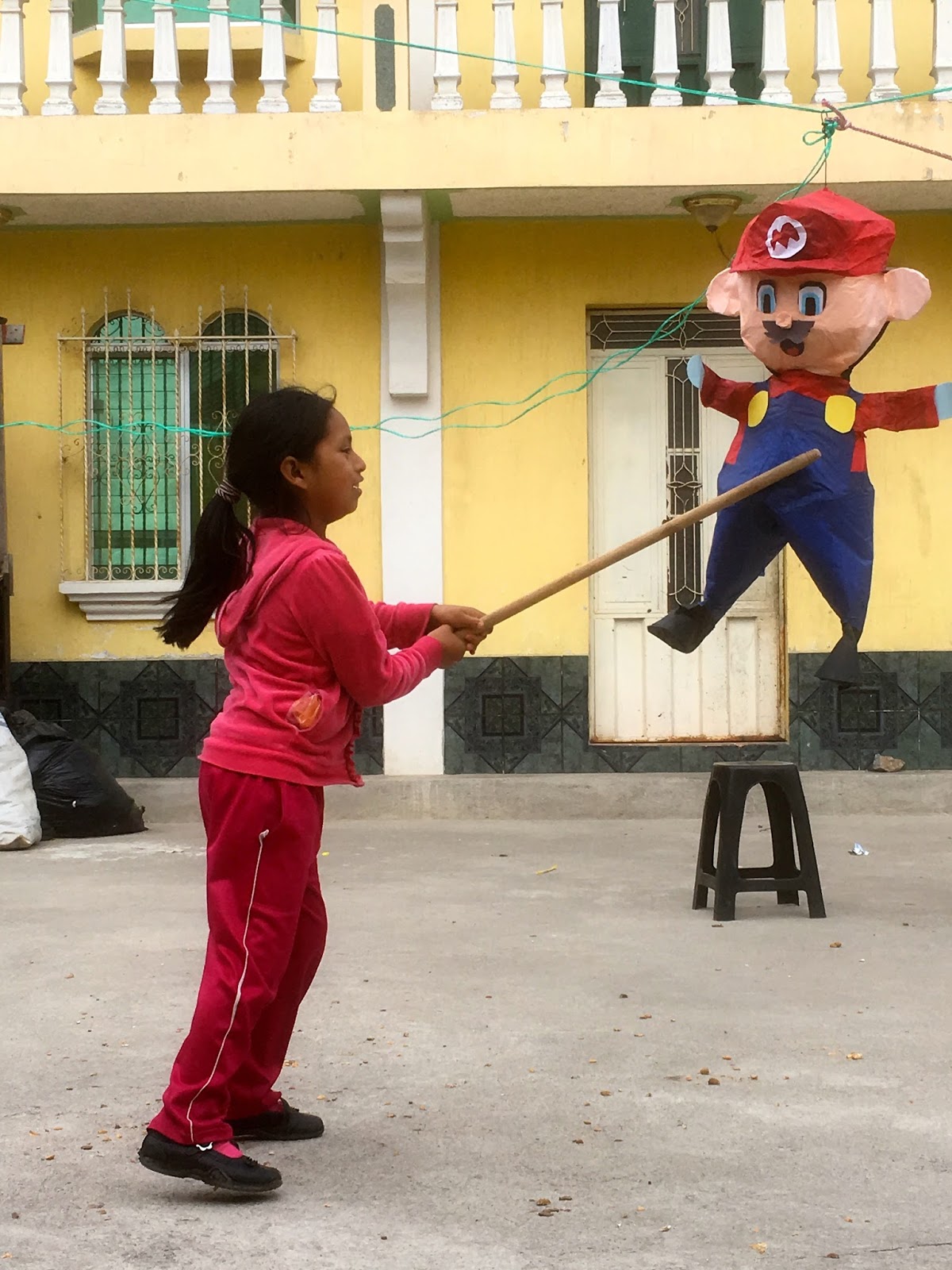
On Thursday, April 27 we threw a birthday party for all of the Family Support Center participants who had birthdays between January and April of this year. We had 7 birthday kids for this party: Arturo (13), Jonathan (8), Ingrid (10), Zulmy (8), Moises (7), Brandon (7), and Miguel Angel (11). To celebrate, we brought two piñatas (one for the bigger kids and one for the littler kids), party favours, presents for the birthday kids, and two cakes. The party started off with the piñata for our youngest group of kids!

Yadira and Daniela giving Mario a farewell hug before the piñata fun begins! 
Luis takes a hard swing ... 
...and breaks the stick!
The pequeños scrambling to collect their candy
Rosemeri shows off her loot!
Brandon and Carlos scored big!
Once the candy from the first piñata had all been scooped up by the kids, we strung up the second piñata for our older kids!

Birthday girl Ingrid takes her turn
It's a swing and a miss for Arturo!
Damaris getting ready to take her first swing 
Evelyn shows Mario some muscle!
Sisters Damaris and Zulmy pack up their candy  
After the excitement of the piñatas, we all went inside for presents and cake. First we handed out the party favours; each kid got a little backpack with a couple of treats, a sticker set, and a fun eraser.

Handing out the party favours
Then it was time for cake! Carmen led us all in a round of "Happy Birthday" before the birthday kids blew out their candles and everyone dug into their pieces of cake.

Carmen leads the group in singing "Happy Birthday"

Daniel is too busy enjoying his cake to care about the icing all over his chin!

Yadira follows Daniel's example and doesn't worry about the icing on her eyebrow
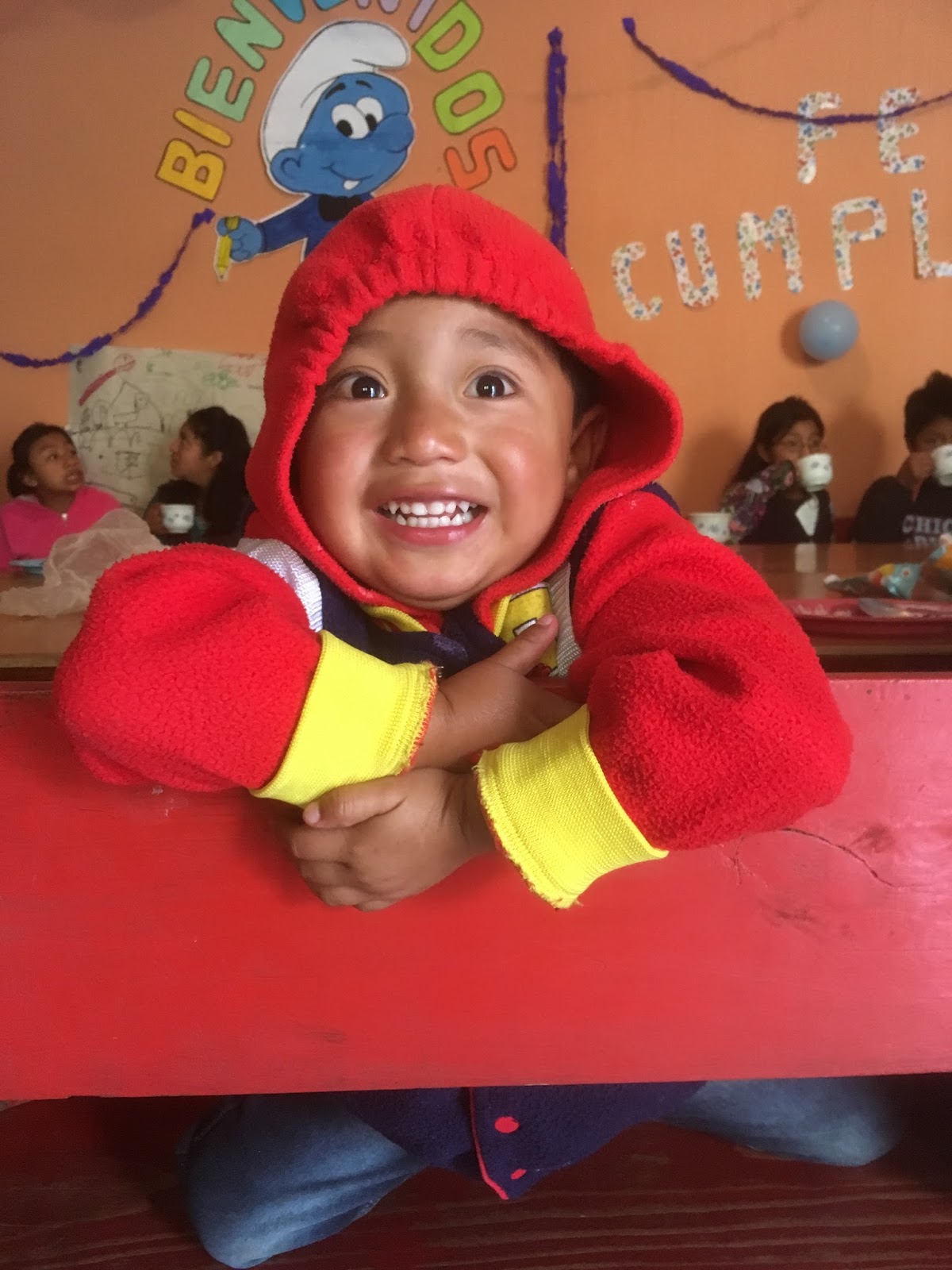
Daniel's smile says it all - the party was a sugar-filled blast! Our Family Support Center kids are truly the most wonderful young people. It's so special and so important to celebrate each and every one of them by marking their birthdays with a fiesta. We can't wait until next time, when we celebrate the May to August birthdays!

Daniel's all smiles

Friday, April 28, 2017

Spotlight on Nutrition Month

Text and photos by Emily Rempel

Throughout the month of March we invited you to share in the work of our Nutrition Program, offering the chance to view this project from a multitude of perspectives. First, we introduced you to the program by talking briefly about what it is that we do, why we need to do it, and how you can help. Take a look at the full Facebook post here.


Then we shared the words of our partner organization, Foundation Todos Juntos, who works with Pop Wuj to help raise funds for our various social projects. A call went out to Todos Juntos' network, as well as those following Pop Wuj, asking for help to continue running this vital project. In 2016 the costs associated with running the Nutrition Program grew significantly due to increased need for medical treatment including specialist care, medications, and baby and toddler follow-up visits. The reality is that this upward projection is expected to continue through 2017, which has certainly been the case over the first few months of this year. Foundation Todos Juntos offers an easy, secure way to make a tax-deductible donation online or via check.

Young Participants at a Nutrition Program Meeting in La Victoria

We then shared the stories of 14-month-old Eliseo and Elias, twins boys who quickly stole the hearts of the entire Nutrition team at Pop Wuj. Eliseo and Elias, both born prematurely, have spent their lives fighting a myriad of health problems and are both suffering from acute malnutrition. Recently the health of Elias took a scary turn for the worse and he had to be admitted into the hospital. Eliseo's health worsened in turn, due to the stresses of being separated from his mother and brother during their hospital stay. With the help of Pop Wuj's Nutrition Program, and the diligence of their parents, the health of the twins appears to be improving. That said, it will still be a long, hard struggle to support the growth and development of Eliseo and Elias. Read about their story here.


On the blog, Environmental Projects Coordinator Mary Gramiak delved into the complex question of why malnutrition is so pervasive in Guatemala. In her post she discussed issues such as the high cost of nutrient-rich food, environmental impacts on agriculture, and systemic discrimination against indigenous populations.

A young Participant in La Victoria playing a game of peek-a-boo with his truck

We were thrilled to share the Nutrition Program success story of Sheily and her mother Doña Eva. With the support of Pop Wuj and the diligence of Doña Eva, Sheily went from being "especially small and fragile" to being happy, healthy, and able to engage in the world with the curiosity expected of an energetic 2-year-old. Read more about Sheily and Doña Eva in our Facebook post.


Following Mary's blog post about the root causes of malnutrition in Guatemala, I wrote a post about the short-term and long-term effects of malnutrition. When a child experiences malnutrition during their vital years of development they risk stunted growth, weakened immune systems, delays to emotional and cognitive development, and lowered IQs. Within a system that already disproportionately discriminates against indigenous populations, the effects of malnutrition become compounded and cyclical. Our Nutrition Program aims to break these cycles.


A young Participant takes in the sights of our Nutrition Program in La Victoria

Our "farewell" to Nutrition Month post highlighted the generosity of our donors who supported us throughout March. We are so grateful to you for working with us in our life-changing Nutrition Program. Together, we will be able to help break the interconnected cycles of poverty and malnutrition for many children and their families in the department of Quetzaltenango. That said, we still need to raise about $11,000, or 33% of our annual budget. Although Nutrition Month has come to an end, our work continues, as does our need for continued support. A donation to our Nutrition Program will allow us to continue serving approximately 110 children per month - children like Eliseo, Elias, and Sheily. Donate today!

Tuesday, April 25, 2017

A Very Feliz Día de la Tierra

Text and photos by Emily Rempel

Happy Earth Day and ¡Feliz Día de la Tierra! Although I'm a few days late with this post, Earth Day is something that Pop Wuj celebrates every day. This year the international campaign for Earth Day was focused on Environment & Climate Literacy.

"Education is the foundation for progress. We need to build a global citizenry fluent in the concepts of climate change and aware of its unprecedented threat to our planet. We need to empower everyone with the knowledge to inspire action in defence of environmental protection."
- EarthDay.org

Environmental protection is fundamental to the work of Pop Wuj, as indigenous Guatemalans suffer the brunt of climate change. The problems of disease, poverty, and malnutrition that our communities face are compounded by a lack of safe and clean water flowing through our rivers, nutrient‐rich soils to support crops, and pollution‐free air to breathe. Our communities are also left vulnerable to irregular weather patterns, such as severe storms and late rainy seasons. In addition to the physical importance of environmental protection, the health of the natural world is also paramount to the spiritual health of many indigenous communities.

At Pop Wuj we work with our communities to help build knowledge of the effects of climate change as well as strategies for combatting it. In our Safe Stove Project we discuss the dangers of burning plastic, including its effects on bodily and environmental health. With every new stove that is built Pop Wuj stresses to the family the importance of not using plastic and other trash as a fuel for cooking.

We also offer an alternative to burning plastic ‐ recycling! Our recycling program collects plastic, tin, paper, and other recyclable materials from our Spanish School and Family Support Center. We also encourage families in our Safe Stove Project to bring their recycling to the Family Support Center.

Once we have enough recycling stocked up we head out to the recycling plant. Our last recycling day was in March, and while being a bit impromptu, it was a success nevertheless. Former Environmental Projects Coordinator Mary and I spent the morning repacking all of the recycling (as some of the costales had broken down) and bringing it down into the school. Then, with the help of Carmelina and our Student Coordinator Elizabeth, we packed the many bags of recycling into the back of our rented moving truck and headed out to the recycling plant.

The moving truck packed tight with costales full of recycling
Interns Emily and Mary hard at work 
At the recycling plant the workers compiled our smaller costales into giant bags, which were then attached to a hook and manually held up, so they could be weighed. We were paid a certain price per pound of recycling, depending on the type. For example, the thick plastic medication bottles from our medical programs were worth more than thin plastic drink bottles.

Student Coordinator Elizabeth scoping out the grounds
Any extra money that we receive from the recycling day (after paying for the cost of the moving truck) is invested back into the projects. Unfortunately this day, because we were asked to deal with our recycling before we had saved up enough, we did not make up the loss on the moving truck. Nonetheless, the unfortunate amount of waste that we had generated though the projects will now be repurposed instead of sitting in a landfill or on the side of the road.

Having the recycling project active at the Family Support Center is another important strategy for supporting "environment and climate literacy." By teaching the Center participants about the principles of "Reduce, Reuse, Recycle" and the impacts of waste on the environment, we're helping to foster a cultural change in the attitudes and behaviours of the kids in our project and their families. To encourage the kids to continue recycling we held a small prize ceremony. Kids that brought in recycling from their homes during the month of March were able to pick out a fun pencil and eraser set. While the prizes were simple, it helped to reinforce the value of recycling at home as well as in the Center. As you can see by their faces, the kids were very happy to pick out their new writing tools.

Teacher Santos begins the recycling prize ceremony
Zulmy brought in the most recycling for the month and was allowed to take the first pick of pencils and erasers!
Jonathan choosing his prize
Rosemeri's turn!
With the rainy season shortly approaching, we will also be starting our reforestation project soon. Our Pop Wuj environmental projects, while simple, help to create cultural change around how we interact with our environment. By promoting recycling, disseminating information about the dangers of the common practice of burning plastic, and working towards reforestation, we can help make small improvements in the health of our world.

Wednesday, April 12, 2017

Big Challenges and Bigger Successes - An Update on our Family Support Center


Text by Emily Rempel
Photos by Elizabeth Barnes

The start of 2017 presented us with a bit of an unexpected speed bump for the Family Support Center. In 2016 the Center had operated in the community center Ixcanul Noj in Llanos del Pinal, with snacks and meals being served in the home of Doña Delfina. However in January of this year we were told that Pop Wuj would be required to pay a large monthly amount to rent the space. This fee would have been unsustainable for Pop Wuj so unfortunately we were tasked with finding a new location in Llanos del Pinal.

Over the course of January and well into February Carmen and Family Support Center staff and participants did extensive leg-work to find us a suitable new location, one that would be within-budget but still have all of the requirements necessary to be an effective space. Finally, on February 20th, we signed the papers for our new location. The following week included a huge moving day and many, many hours of dedicated work from the Family Support Center and Pop Wuj staff and volunteers to get the project up and running. On February 27th we were finally able to re-open the doors to the Family Support Center. 


The minute the doors opened, the FSC kids came running through to explore their new home. Our new Center is located behind a store, just a short walk from the local school where many of the students spend their mornings. The space has a large cement courtyard (which is regularly used for energetic soccer games), two classrooms, and a kitchen/dining room. When Carmen asked the kids if they were happy with the new location, she was met by a resounding "¡Sí!" and lots of smiles.

Daniela, Yadira, and Andrea are all smiles in the new Center! 

Another exciting addition to the Family Support Center is our new chef, Kevin Jimenez. Kevin has been preparing healthy and delicious hot lunches and snacks for the kids. During our first meeting with the mothers of the Family Support Center several of them shared that their children had given Kevin rave reviews! Moving forward, Kevin and Carmen will be trying to buy as much produce for the Center as possible from the mothers themselves. Not only will this provide the kids with fresher vegetables, but it offers another way for the Center to support the families of Llanos del Pinal (and vice versa)!

Boys Cook Too!  Julio and Arturo help Kevin in the kitchen

Our older group of students, the mayores, are being taught by FSC director Shaaron. Not only is Shaaron teaching while acting as Director, but she is also working on her Masters degree. The younger group of school-age students, the medianos, are still being taught by Santos, who, like Shaaron, is also pursuing post-secondary education. Our youngest group of kids stay at the Center all day, as they are too young for school. They are cared for by Doña Silvia and Angelica. Angelica is also attending university, but still working with the kids whenever possible. We are so proud of our dedicated, passionate, and hard-working staff! 


Eagerly Awaiting Snack Time

Sharp Hopscotch Skills 
The Center has been up and running strong for just over a month now. On March 8th, to mark International Women's Day, Shaaron and Santos planned some fun activities for the kids. One of the most popular was a game with balloons, where partners had to hold a balloon between their heads and race from one end of the courtyard and back without dropping their it. The message shared with the kids at the end of the activities was that girls can do anything that boys can do! 

Racing Ahead!

Hirrany and Damaris, concentraing hard on keeping their balloon safe!

We also celebrated World Water Day on March 22nd. The kids learned about waste water, the importance of boiling water before consuming it, and how they can help to keep our waters clean and safe. 


"The Importance of Water" - A beautiful informational poster by one of our talented participants
Although 2017 started off slowly and (very) stressfully, we're so excited to be back on track, providing 25 kids from Llanos del Pinal with a safe space to grow, play, and learn. Thank you all for your continued support of our project! 


Student Coordinator Elizabeth taking a group selfie with Yosvin and Andrea

Group coloring session with Pop Wuj Spanish student Jamie


Tuesday, March 28, 2017

Tom's Visit, Part 1: A Guatemalan Thanksgiving

Text by Tom Kemple

Tom Kemple is a sociology professor at the University of British Columbia and a long-term friend of Pop Wuj. With his colleague Sylvia Berryman in Philosophy, he has been bringing groups of students to study in Guatemala since the summer of 2010. This past November and December he spent 5 weeks studying Spanish, building stoves, helping out in the Pop Wuj Clinic and Nutrition Program, and having fun at the Family Support Center. What follows are some writings from his trip created in the course of his research project on university fieldshools and study abroad programs, titled “Global Citizenship at Home and Abroad.”  We hope you enjoy Tom's stories and insights as much as we enjoyed having him back at Pop Wuj.

Dr. Herman, Nurse Luby, and I arrived around 8:30 a.m. on Thursday (American Thanksgiving) by microbus in Llano del Pinal, the indigenous village near Xela that I’ve been visiting a few times a week to build safe stoves or to play with the kids in the Family Support Centre. I had been talking about my experiences in this village with my teachers in Spanish classes, and reading about its fascinating history in Greg Grandin’s The Blood of Guatemala: A History of Race and Nation. Some of the fist massacres in the early years of the conquest took place here; communal land was commodified and divided up into plots among families during the liberal reforms of the late 19th century; and it was a centre of resistance in the early 1950s when a leader from this community, an illiterate peasant named Valentin Coyoy Cruz, was murdered, probably by the indigenous elites from the city who were against the radical agrarian reforms of the socialist-leaning government.

To an outsider like me the village seems quiet, poor, and friendly, and yet it also holds answers to many of the questions I brought with me to Guatemala. I have been learning about how the problems which are most evident here – extreme poverty, precarious health, ignorance, adolescent pregnancy, and chronic malnutrition – have their roots in both the recent and the distant past.

I had volunteered to help out with Pop Wuj’s Nutrition Program for children under 3 years of age. When Luby asked me whether I was a doctor or a medical student, as are most gringos at the school these days, I told her ‘Doctor de Sociologia.’ When I later made the same joke to Carmen, who oversees all the social projects, she also laughed: “Then give me a pill for a good society, please!"

It seemed incredible that all the boxes we were unloading were just for our day’s work, and I was ever more surprised when we started pulling computers and wires out of them. Dr. Herman led me to a room filled with women and children (the mother and little girl whose stove we were building yesterday smiled shyly at me as we passed) and then explained our first task: help the mothers place their babies in the white sheet under the scale while he checked their weight, and then hold their heads still on the table while he measured their height and called out the numbers to Victoria behind the laptop at the end of the table. This part of the morning was the most overwhelming: kids are adorable at any age (and often annoying!), but passing these 24 little lives through our hands was heartwrenching. Most were under 2, and several just a few months old; some peered sweetly and trustingly at us as we lowered them gently into the sheet or stretched them out onto the table; others put up a fight, cried out in fear, gave us a suspicious look, or stared at us angrily.

A participant and his mother in La Victoria in February.
(Photo by Emily Rempel)

For each child under 2 we also took a cranium measurement (perimetro cefálico), which reminded me of the anthropometric practice of western ethnologists among so-called ‘savages’ in the late 19th century. Even the most resistant babies calmed down for this part, and yet it still seemed cruel to fit these tiny human beings in their first years of life into a numerical grid of weights and measures — ‘estatura’/‘edad’/‘peso’/‘genero’ (height/age/weight/gender). Dr. Herman lightened the mood with the occasional laugh at a struggling child, a few kind instructions to the mother, or a casual remark to me about a child who was especially tiny or large. As they looked up at us as if to pose a question or issue a command, I could hardly concentrate on the numbers being recorded in the computer (ranging from around 13.99pds and 63cm to 22.51plds and 81cm, as I later noted). When I described these experiences over email to my colleague Sylvia, she pointed out to me that this commitment to record keeping is not just a bureaucratic protocol done for its own sake, but also a way of showing care, not cutting corners, and respectfully enacting a basic right.

As we moved to the computers in the room across the corridor, I mused to myself that in a sense our next task would involve flattening out each of these vulnerable bodies onto a two-dimensional graph. Dr. Herman patiently instructed me on how to navigate between the plastic charts plotting standard deviations and the data just entered into the computer (translated into English according the program that the Timmy Global Health shares with Pop Wuj, and using a mix of both metric and standard measures). Meanwhile, the mothers and their children played together on a finger-painting project and listened to Carmen speak about the importance of nutrition, all to the tune of a Brahms waltz blasting from a pair of speakers behind us.

Our final task was to note any changes in height and weight from last month’s visit, which Dr. Herman used for his diagnoses and prescriptions, and which I dutifully entered into the computer. As the babies in front of us laughed, cried, and played with their mothers in Quiché and Spanish, I conjured up a picture of them being ‘institutionally captured’ (in my sociological jargon) by a medical system projecting out from our computer screens and communicating to us in English. But I could also see that the Nutrition Program included an important educational component, a ritual element of play and socialization, and even a kind of musical therapy.


Medical Spanish Program students do a check-up with Jesler Juanito and his mother Doña Victoria in La Victoria in February.  Jesler Juanito suffered a serious health setback last year with an outbreak of rotavirus and has made excellent proress since then. (Photo by Emily Rempel)

The diagnoses were alarming and sad, nearly all falling into the ‘Stunting’ classification (‘chronic’ or ‘severe’); most suffering from ‘Malnutrition’ (many ‘chronic’, several ‘severe'); and a few ‘Underweight’ (‘chronic’) as well. At Dr Herman’s seminar a couple weeks later, I found out that 100% of the families in Llanos who benefit from the Nutrition Program live in ‘extreme poverty’, officially defined as living under a dollar per person per day. (50% of Guatemalan children are malnourished, and 1.2 to 3.6% of these are acutely malnourished).

Nearly every prescription followed a similar pattern, varying according to severity and age: NutriButter™ supplement 3 packs everyday for 21 days (I later learned that the other supplements, Plumpy Nut and Maní, were out of stock that day); 23 mg pills of Zinc Oxide once a day for 21 days; Incaparina everyday (a thick drink that tastes like corn, served warm to everyone that morning with a banana as a snack). This data then made its way to Nurse Luby’s laptop at the table next to us, where several girls from the community filled the packages for the mothers to take home. With still more work to do, Dr. Herman went on to call out the numbers of patients (written on the back of their hands) for additional consultations, beginning with the twin boys who had arrived late with their beautiful mother, one large and lively the other thin and lethargic, followed by several children with colds, stomach aches, and other intestinal ailments (7 in all). In Dr. Herman’s seminar a few weeks later, I was cheered to learn how the Nutrition Program improves the weight and height of most of the children who participate in it, and prevents acute malnutrition in all of them.

As I rode back with Carmen to the school for my 2 p.m. Spanish class, I thought about the irony that today was American Thanksgiving, which I remember from my childhood as a day spent among family, overeating to my heart’s content. A morning of weighing and measuring malnourished babies and prescribing Nutri Butter™ and Incaparina to indigenous families seemed worlds away from stories of Pilgrims and Indians eating turkey. That evening I went as usual to the weekly dinner at the school, a potluck featuring a huge variety of delicious dishes, with dessert. Sharing a sumptuous meal with teachers, students, and friends of the school made me feel especially thankful to be here.