Showing posts with label Reforestation. Show all posts

Tuesday, April 25, 2017

A Very Feliz Día de la Tierra

Text and photos by Emily Rempel

Happy Earth Day and ¡Feliz Día de la Tierra! Although I'm a few days late with this post, Earth Day is something that Pop Wuj celebrates every day. This year the international campaign for Earth Day was focused on Environment & Climate Literacy.

"Education is the foundation for progress. We need to build a global citizenry fluent in the concepts of climate change and aware of its unprecedented threat to our planet. We need to empower everyone with the knowledge to inspire action in defence of environmental protection."
- EarthDay.org

Environmental protection is fundamental to the work of Pop Wuj, as indigenous Guatemalans suffer the brunt of climate change. The problems of disease, poverty, and malnutrition that our communities face are compounded by a lack of safe and clean water flowing through our rivers, nutrient‐rich soils to support crops, and pollution‐free air to breathe. Our communities are also left vulnerable to irregular weather patterns, such as severe storms and late rainy seasons. In addition to the physical importance of environmental protection, the health of the natural world is also paramount to the spiritual health of many indigenous communities.

At Pop Wuj we work with our communities to help build knowledge of the effects of climate change as well as strategies for combatting it. In our Safe Stove Project we discuss the dangers of burning plastic, including its effects on bodily and environmental health. With every new stove that is built Pop Wuj stresses to the family the importance of not using plastic and other trash as a fuel for cooking.

We also offer an alternative to burning plastic ‐ recycling! Our recycling program collects plastic, tin, paper, and other recyclable materials from our Spanish School and Family Support Center. We also encourage families in our Safe Stove Project to bring their recycling to the Family Support Center.

Once we have enough recycling stocked up we head out to the recycling plant. Our last recycling day was in March, and while being a bit impromptu, it was a success nevertheless. Former Environmental Projects Coordinator Mary and I spent the morning repacking all of the recycling (as some of the costales had broken down) and bringing it down into the school. Then, with the help of Carmelina and our Student Coordinator Elizabeth, we packed the many bags of recycling into the back of our rented moving truck and headed out to the recycling plant.

The moving truck packed tight with costales full of recycling
Interns Emily and Mary hard at work 
At the recycling plant the workers compiled our smaller costales into giant bags, which were then attached to a hook and manually held up, so they could be weighed. We were paid a certain price per pound of recycling, depending on the type. For example, the thick plastic medication bottles from our medical programs were worth more than thin plastic drink bottles.

Student Coordinator Elizabeth scoping out the grounds
Any extra money that we receive from the recycling day (after paying for the cost of the moving truck) is invested back into the projects. Unfortunately this day, because we were asked to deal with our recycling before we had saved up enough, we did not make up the loss on the moving truck. Nonetheless, the unfortunate amount of waste that we had generated though the projects will now be repurposed instead of sitting in a landfill or on the side of the road.

Having the recycling project active at the Family Support Center is another important strategy for supporting "environment and climate literacy." By teaching the Center participants about the principles of "Reduce, Reuse, Recycle" and the impacts of waste on the environment, we're helping to foster a cultural change in the attitudes and behaviours of the kids in our project and their families. To encourage the kids to continue recycling we held a small prize ceremony. Kids that brought in recycling from their homes during the month of March were able to pick out a fun pencil and eraser set. While the prizes were simple, it helped to reinforce the value of recycling at home as well as in the Center. As you can see by their faces, the kids were very happy to pick out their new writing tools.

Teacher Santos begins the recycling prize ceremony
Zulmy brought in the most recycling for the month and was allowed to take the first pick of pencils and erasers!
Jonathan choosing his prize
Rosemeri's turn!
With the rainy season shortly approaching, we will also be starting our reforestation project soon. Our Pop Wuj environmental projects, while simple, help to create cultural change around how we interact with our environment. By promoting recycling, disseminating information about the dangers of the common practice of burning plastic, and working towards reforestation, we can help make small improvements in the health of our world.

Wednesday, July 6, 2016

Reforestation 2016

Text by Nadia Mondini and photos by Dawn Liberto (unless otherwise noted)

On June 24, we had a special day at Pop Wuj: reforestation day in Llanos del Pinal and Xecaracoj.

Tree planting is one of our main environmental projects. Although we plant in several other communities, in Llanos del Pinal and Xecaracoj especially reforestation complements the safe stove program. Pop Wuj stoves are designed not only to prevent smoke-related health issues, but also to save more than 50% of firewood: in order to reinforce this step against deforestation, during the rainy season we plant tree saplings on lands owned by new participants in the Safe Stove Project and families in the Scholarship Program.

Every year, reforestation gathers Pop Wuj staff, students, teachers and volunteers, safe stove and scholarship families, and children from the Family Support Center for a day of work and fun out in the green of Llanos.

Even after two hours of dividing trees up by families and organizing trees into boxes according to their destination on Wednesday afternoon, Nadia is excited for reforestation on Thurdsay morning! (Photo by Elizabeth Barnes)
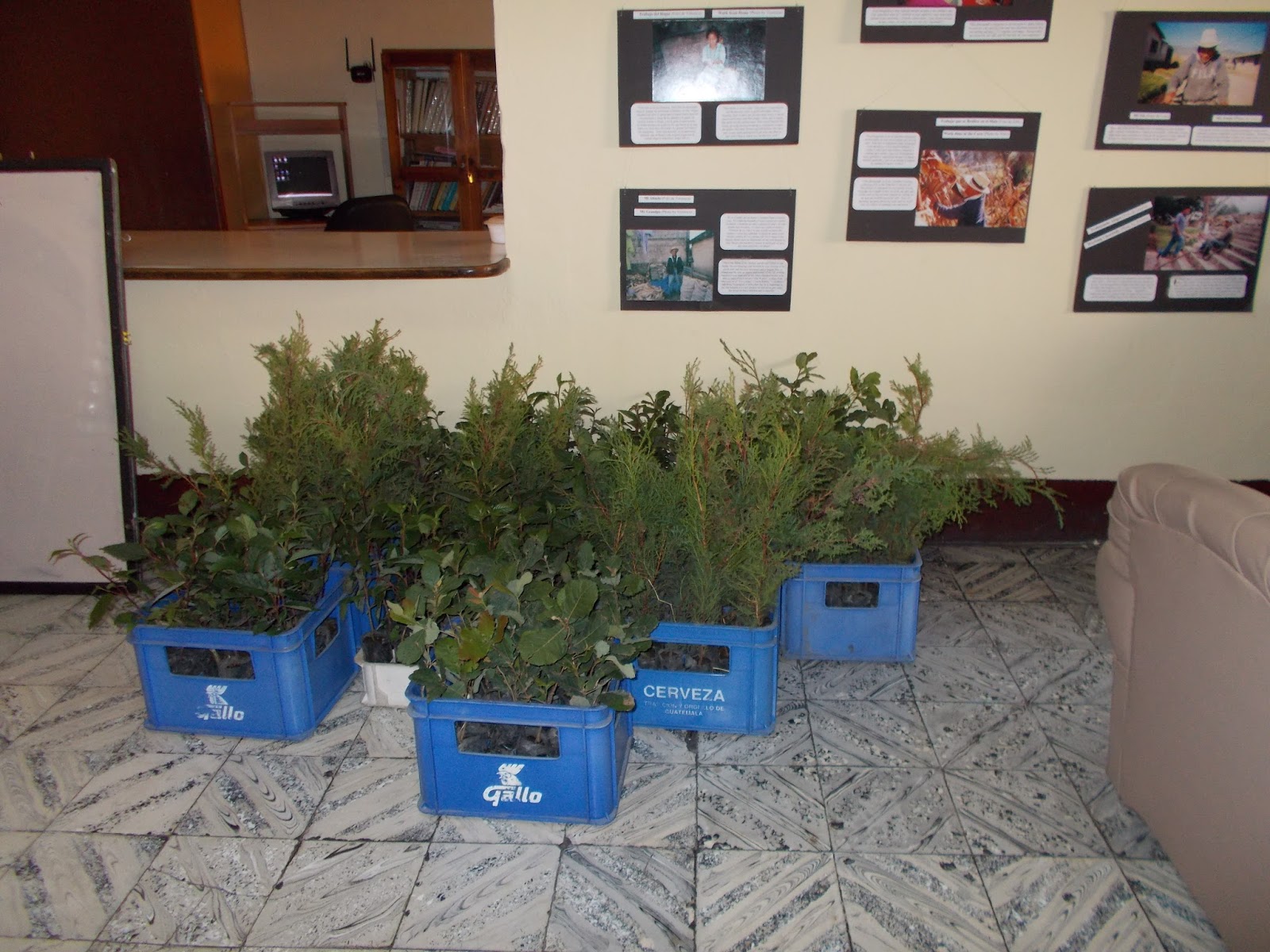
Saplings wait downstairs to be loaded into a chicken bus for their trip to Llanos del Pinal. (Photo by Elizabeth Barnes)
We partnered with 14 families, all of whom received five trees to plant by their houses, and 7 of whom also received trees planted on other properties used for firewood or farming.

Pop Wuj teacher Alberto shows a group of 5- to 9-year-olds how to plant their saplings. Kids of all ages helped with planting, from the 2-, 3-, and 4-year-olds in the youngest class at the Family Support Center to the teenagers who participated in the FSC last year and aged out.
FSC participants show off their saplings before planting. This year we planted a mix of pino blanco, aliso, and ciprés (white pine, alder, and cypress), all species that do well in the Western Highlands of Guatemala. 
This year, we were able to plant 275 saplings belonging to three indigenous species, as well as one eucalyptus tree for each family, very appreciated for its medicinal effects. Since we had to reach different patches of land, we split up into four groups. I joined the last group, which went the furthest and consisted of a funny mix of children, adolescents and the women owning the land.

Everybody was in a good mood, laughing and telling “bromas” (jokes). Our chicken bus took us high up the slopes of Santa María volcano in a beautiful drive across corn, bean and onion fields. When we reached our destination, everybody helped cleaning the lands from shrubs and weeds and digging little holes for the young trees. It was a challenging task, but together we made it, and finally left the lot with its share of young trees waiting for some afternoon rain. After a well-deserved banana and orange snack, we then went back to the lowlands in a fun pickup drive altogether.

Evelyn peels plastic wrapper off a sapling with care not to damage its fragile roots. (Photo by Elizabeth Barnes)
For me as a relatively new intern at Pop Wuj, reforestation day was a highlight. It brought together such a lot of different people, all having fun, all learning from each other, and all contributing something to our common effort for a small step against deforestation and firewood shortage.

Thursday, July 23, 2015

Pop Wuj and the Pedagogy of the Oppressed

Guest blog by Kelly Dent, a current Pop Wuj Social Work Spanish student.
Photos by Amy Scheuren

"A real humanist can be identified more by his trust in the people, which engages him in their struggles, than by a thousand actions in their favor without that trust. Trusting the people is the indispensible precondition for revolutionary change.” – Paulo Freire

I read Paulo Freire’s book, Pedagogy of the Oppressed, before coming to Guatemala. I found myself glued to the pages as I reflected on my inherited privilege and elitism, and my role in the war against oppression. I then arrived to Pop Wuj only to find the same messages shared with me during my cultural orientation here. This made me incredibly excited to work with an organization that had a philosophy of work with the people here and not for the people here. 

For example, when helping with a reforestation project the other day, I learned that the group (of mostly women) that we met with to plant the tress, existed for many years before Pop Wuj joined. Pop Wuj aids through volunteer support, relationship, dialogue and financial resources, but the group already existed. Pop Wuj did not join the group explaining how they should change things to make it better. They joined the group asking how they can help and support what the indigenous folks are already doing for themselves. This is the philosophy of Paulo Freire's book. 

Meeting with the scholarship families before planting the trees

Carrying the seedlings to the planting site

What does it look like to live in complete solidarity with the oppressed and be a part of their revolution? What more can we do? Much more I’m sure. It's a process of committing ourselves to solidarity with the oppressed and a constant process of humbling and re-examining myself in the process. This is the process that I see Pop Wuj living out and it is a privilege to witness.

“The more radical a person is, the more fully he or she enters into reality so that, knowing it better, he or she can better transform it. This individual is not afraid to confront, to listen, or to see the world unveiled. This person is not afraid to meet the people or to enter into dialogue with them. This person does not consider himself or herself the proprietor of history or of all people, or the liberator of the oppressed; but he or she does commit himself or herself, within history to fight at their side” (pg. 39).
  
According to Paulo Freire (pp 89-92), there are four very important concepts that are integral in the process of obtaining inner freedom and aligning with the oppressed to create change:

1. LOVE
- Dialogue cannot exist in the absence of a profound love for the world and for people
- Love is an act of courage, not of fear. Love is a commitment to others

2. HUMILITY
- Dialogue is broken if the parties (or one of them) lack humility
- How can I dialogue if I always project ignorance onto others and never perceive my own?
- How can I dialogue if I consider myself a member of the in-group, of “pure” men and women, the owners of truth and knowledge?
- How can I dialogue if I am closed to - and even offended by - the contribution of others?
- How can I dialogue if I am afraid of being displaced, the mere possibility causing me torment and weakness?

3. FAITH IN HUMANKIND
- Faith in their power to make and remake, to create and re-create, faith in their vocation to be more fully human (which is not the privilege of an elite, but the birthright of all)
- The dialogical man believes in others even before he meets them face-to-face
- This becomes a horizontal relationship of which mutual trust between the dialoguers is the logical consequence

4. HOPE
- If dialoguers expect nothing to come of their efforts, their encounter will be empty and sterile, bureaucratic and tedious

5. CRITICAL THINKING
- True dialogue cannot exist unless the dialoguers engage in critical thinking – which perceived reality as process, as transformation, rather than as a static entity

Being a part of Pop Wuj's projects is an opportunity to see these philosophies and concepts lived out in real time with the oppressed indigenous population in Guatemala. I highly recommend reading the Pedagogy of the Oppressed before arriving to enhance your understanding of these concepts and the great work of this organization. 

Even the youngest among us carried seedlings and planted trees!
 
Planting the seedlings

Wednesday, July 8, 2015

Reforestation with Stove Families and the Family Support Center

Text and photos (except as noted) by Amy Scheuren

Guatemalan schools have their mid-year break at the end of June.  Taking advantage of the school, we scheduled our Llanos del Pinal reforestation day for Thursday June 25, 2015. 

On Wednesday Pop Wuj Spanish students helped pick up 300 seedlings in anticipation of an early start on the reforestation day.  We purchased a mix of alder birch, cypress, encino (oak), and eucalyptus seedlings to plant on three pieces of land in and around Llanos del Pinal


Counting and loading the seedlings
Photo by Oscar Rodriguez
300 seedlings


On Thursday morning, Pop Wuj students, volunteers, and staff headed to Llanos del Pinal and met the children and youth of the Family Support Center as well as some of the Safe Stove Project families.  We divided into three groups and planted trees on three different pieces of land.  We always plant on private land, owned by the family members in the communities in which we work. 

Looking for a good spot to plant

A freshly planted cypress seedling

I traveled with the oldest group of Family Support Center participants to a piece of mountainous land in Chuicaracoj, high above Llanos del Pinal.

Angelica, planting a tree

After we planted our seedlings and ate a snack, we headed back down the mountainside.  On the walk back (which took about an hour and half!) we collected a LOT of plastic bottles.  We even found extra costales (sacks) to carry all of the plastic.  There is no trash collection in rural Guatemala and recycling is even less common.  We collected the plastic and will later take it to a private recycler in Xela.

Walking back and collecting plastic

Brandon and Angelica even asked when we could take another hike and collect more plastic!

Tuesday, June 2, 2015

El Día del Árbol

Guatemala celebrated Arbor Day on May 22.  We recognized the day with a little bit of tree education and planting.  Because it's just the beginning the rainy season, the land isn't ready for large reforestation projects, however, we planted ten trees at the homes of three Family Support Center families.  The families will care for and tend the seddlings until the rains really start.

Approximately a dozen of Pop Wuj students and teachers headed out to Llanos del Pinal with 10 seedlings, including white pine, cipres, alder birch, and eucalyptus. 

First we talked about the types of trees we would plant today.
We talked about the trees and their uses.  Many of the children and teachers told us that they use the trees as medicinal plants.

Walking toward the homes where we would plant

Oscar, very proud of his white pine seedling

Amy and Amy planting the first tree of the day

Ismael watering the seedling


Guayo with his seedling

Planting another white pine

Chipping in to plant a cipres seedling


Planting an alder birch

Monday, August 18, 2014

Branching out: Reforestation in La Victoria

On Thursday, July 31st, a group of students and staff members of Pop Wuj climbed up a trail on the mountainside in La Victoria to plant trees. This activity is part of the Reforestation Project at Pop Wuj. We planted cyprus, white pine, and holm oak (encino).

Carmencita, speaking with community members and Pop Wuj students before starting the activity.


They were accompanied by the families that owned the plot of land on the mountainside.


Everybody worked together to dig holes, fill them with water, place the "arbolitos" (seedlings) and pack the dirt around them.


We made sure to water the little trees sufficiently to keep them healthy despite the recent lack of rain in the area.


We planted 35 trees and distributed the remaining 40 trees to the families who attended the community meeting.

Thursday, July 3, 2014

Reforestation in Llanos del Pinal

Bringing together the Family Support Center participants and staff, safe stove project families, and Pop Wuj students, teachers, staff, and volunteers, we planted 235 trees in Llanos del Pinal last week.

Carmen, director of Pop Wuj's social projects, and Doña Delfina of the Family Support Center, speak together about the importance of the day's mission to reforest the land.
The reforestation took place near the Family Support Center in the town of Llanos del Pinal.

Pop Wuj purchased a variety of seedlings in anticipation of the activity, including white pine, red pine, cypress, and encino (oak).  We divided into four groups and each group walked/hiked to a different piece of land in Llanos del Pinal.

The kids proudly raise up their trees, ready to plant!
The oldest participants of the Family Support Center and the Pop Wuj students with the most energy hiked up the mountainside for over an hour while the younger group stayed closer to the valley.

Carmen helping Amy plant a tree.

Amy with a handful of trees.

The "medianos," with Amy, Carmen Maria, Pop Wuj students and teachers, and stove families hiked for 15 minutes or so before arriving at the family's land to plant the trees.


We planted 50 trees and then hiked a bit more up the mountainside.

Guayo and Ismael plant a cypress seedling.

Rolling down the hill, now a regular post-reforestation activity for the Family Support Center kids!

Thank you to all of the project participants, staff, Pop Wuj students, teachers, volunteers, and staff for making our reforestation day a success!