Tuesday, February 18, 2014

Safe Stove Project: Building Begins


The past three weeks many Pop Wuj students have volunteered their time to help out with construction of safe stoves on Wenesday mornings. 


Pop Wuj coordinators:Shanti & Dawn along with med students: Ben, Inge & Dan working on Stage 2


So far we have completed the construction of one stove and started the construction of four  more. The building process takes place in three stages. In the first stage, the base of the stove is built using cinder blocks and cement. 


In the second stage, three layers of bricks are added onto the base and are held together by cement and a mixture of clay "barro" and "panela" (unrefined whole cane sugar). 


Mynor (Safe Stove Expert & Pop Wuj Spanish Teacher) finishing up Stage 2
Here is Doña Michaela from Tierra Colorada Baja (a rural community outside of Xela). This was her cooking space before she received her safe stove. 


During Stage 3 the construction of the inside of the stove is completed and the "plancha" (metal stove top) is added along with the chimney. Cement is added on top of the last layer of bricks to firmly hold the plancha. It also gives the stove a great look! 


Here is a picture of the final product! Stage 3 is complete for Doña Michaela. She was the first to receive a stove this year! 

Friday, February 7, 2014

Safe Stove Project: Delivery of Materials January 2014

On Wednesday January 22nd stove materials were delivered to 10 homes in the community of Llanos del Pinal to prepare for the construction of safe stoves in the weeks to come.


First stop: picking up bricks and clay at Xela's local brick maker


The Safe Stove Project was created to combat respiratory illnesses caused by the constant interaction of cooking with open fires and deforestation due to increased consumption of firewood. Furthermore, this increases protection for children and minimizes the frequent accidents that can occur around an open fire in the home.


Pop Wuj volunteer coordinators, Spanish students, teaching staff, and safe stove beneficiaries worked hard all morning to deliver the materials.


Each home recieved 110 bricks, concrete blocks, clay, cement, metal parts to construct the chimney, and a "plancha" (stove top). 

Wednesday, February 5, 2014

Preparations for the opening of the Family Support Centre 2014

The last two weeks have been spent preparing for the inauguration of the Family Support Centre for 2014. 


A lot of effort has been made by personnel at the Family Support Centre, Pop Wuj students and Project Coordinators in ensuring that the classroom and equipment are all clean and freshly painted for the coming year.


Potentially dangerous rotting boards on the play equipment were replaced.


All this was achieved whilst Llanos del Pinal was without water for almost two weeks, delaying the opening of the Centre.  However, the water situation has now been resolved which enabled the children to return just two days later than anticipated.


Sunday, January 26, 2014

Nutrition Meetings, January 2014

Nutrition meetings were held in Buena Vista and La Victoria on Wednesday, January 15th and in Llanos de Pinal on Thursday, January 16th.  In preparation for the three nutrition meetings, the Pop Wuj Medical Spanish students and staff prepared bags of vitamins and Nutributter and/or Mani+ to be distributed to the participant families. 

Luby, the Pop Wuj staff nurse, begins registering the families as they arrive in Llanos del Pinal.

Pop Wuj Medical students and staff reviewed appropriate feeding practices for babies depending on their age.

Pop Wuj Medical Spanish students perform an educational skit for the mothers.
Carmen reminds the mothers about the best way to use the fortified peanut butter supplements.
The Pop Wuj Nutrition Program is slowly switching to Mani+ (Mani Plus) which is a different type of fortified peanut butter.  Mani+ is formulated to meet the deficiencies in the typical Guatemalan diet.  Mani+ is manufactured in Guatemala and we hope that the supply issues will be resolved shortly so that we can make the final transition from Nutributter (produced in the U.S.) to Mani+.

Snack time!

All the babies were weighed and measured before meeting with a doctor for their nutrition consult.  There are currently approximately 80 babies enrolled in the project.  The largest group is in Llanos del Pinal where we expanded our program in June, 2013.  In Guatemala 48% of children under 5 years of age are chronically malnourished.

Some babies love nutrition meetings!
At the end of the meeting each mother receives a month's supply of prenatal vitamins as well as month's supply of children's vitamins for each older child in the family.  Each baby between the ages of 6 and 24 months receives a month's supply of fortified peanut butter (Nutributter or Mani+).

Some babies do not.
Pop Wuj will return to Buena Vista and La Victoria on February 6th and to Llanos del Pinal on February 13th for the next meeting.

Saturday, January 18, 2014

Scholarship Program Annual Assembly and Year-End Summary

On December 11, 2013, Pop Wuj hosted scholarship program students and their families for the Annual Pop Wuj Scholarship Assembly.

The day started will a health check-up for the approximately 90 students who attended the assembly. The Pop Wuj clinic was bursting with students who were weighed, measured, and given anti-parasitic and fluoride treatments.  Any student that was ill also had a full consult with one of our doctors.


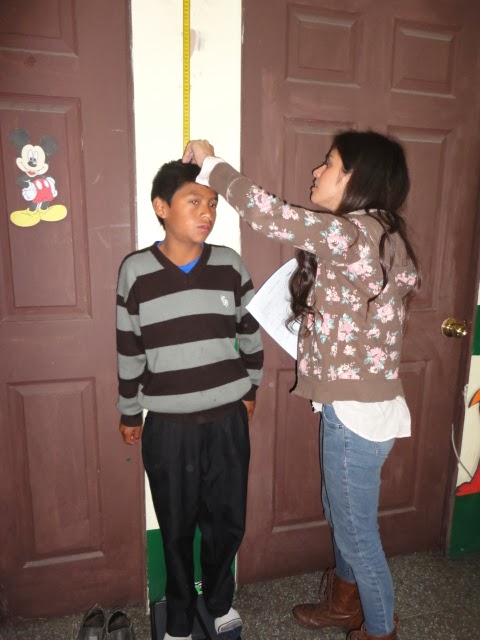
Carmen Maria measures a scholarship student

Ashley handles the fluoride treatment.


Next the students prepared cards and letters to send to their padrinos and madrinas (scholarship sponsors).

Working on cards and letters

Carmen de Alvarado, director of Pop Wuj's social projects, began the formal presentation by acknowledging the families' strength and effort in supporting their children's educations.

Next we honored the students who graduated from primary school (6th grade), basico (9th grade), and high school.  This year seven girls and eight boys graduated from primary school (6th grade), twelve girls and one boy graduated from básico (equivalent to 9th grade), and two girls and four boys graduated from high school. In addition, two students continue to study in post-secondary programs.


Some of the 2013 high school graduates
Some of the 2013 básico (9th grade) graduates

Some of the 2013 primary school graduates


After a delicious lunch of tamales de arroz (rice tamales), each family met individually with Carmen to confirm educational plans for next year and receive their December scholarship payment.  The day ended with "photo shoots" for each community group or family.


Chirijkiak Scholarship Students

Costa Sur Scholarship Students

Llanos del Pinal Scholarship Students

San Juan Ostuncalco Scholarship Students

Pacaxoj (Momostenango) Scholarship Students

A small group of the Xeabaj Scholarship Students
Roney Alvarado, Pop Wuj Director, Doña Silvia, Carmen de Alvarado, and Juan Luis

Vasquez Vail siblings

López Calel siblings

***
In 2013 the Pop Wuj Scholarship Program provided scholarships to 127 students, ranging from kindergarten to university level. Carmen de Alvarado, the Pop Wuj Social Projects Director, and Pop Wuj social work Spanish students met monthly with the scholarship families in Chirijkiak, San Juan Ostuncalco, and Llanos del Pinal. Carmen also met with the group in Xeabaj and with individual families who traveled to Xela to submit report cards and discuss educational challenges and school plans for 2014.


The 2014 school begins in mid-January so students are just now returning to class.  We expect to have well over 130 students in the scholarship program in 2014. 

Friday, December 13, 2013

Life as a Pop Wuj Student and Volunteer

Text and Photos by Travis McMullen 

My time studying at Pop Wuj was incredibly enjoyable and left with me with a range of treasured memories. Apart from learning Spanish, the main reason I chose Pop Wuj was their reputation for their projects which assist the local community. 

Life at the school follows a general formula – class in the morning or afternoon. I studied in the mornings from 8:00am to 1:00pm, Monday to Friday. As I came with zero Spanish, my first few weeks were filled with learning the practical theory behind the Spanish language, as well as useful and common phrases and words. This then progressed to looking at the different tenses, to free range conversation – focusing on the areas and interests that I had. Learning took the form of a variety of different methods, to keep things constantly fresh, interesting and active. A sample includes:
  • Free range conversation to practice speaking and listening – and in my case – also learning to speak without a heavy Australian accent
  • Going on a trip to the market, to discuss foods, cultures and practice Spanish when purchasing food for the weekly school dinner or event
  •  Reading newspaper articles – to practice comprehension and articulation – then to discuss the article and learn more about Guatemalan news, politics, history and culture
  • Reading a short story in Spanish, then reading the English translation, making notes, then repeating the story back in Spanish – a great way to learn new vocab, or use existing words in a way which describes the story
  • Traditional text book style learning
Originally I planned to study for four weeks. However, I was having too much fun and really wanted to get a firm grasp on the language. Xela is a fantastic place to learn and my stay turned into nine weeks. 
Apart from traditional studying, the school also offers additional activities most days, which are a mixture of learning, adventuring, and spending time with fellow students and teachers. Movies, lectures, stove building, visits to the Family Support Center, and weekly excursions. The weekly lectures provided a great way to learn more about Guatemalan culture and the teachers told personal stories about each of the topics – always leaving you with much to think about. Pop Wuj also offers many interesting excursions and I was lucky enough to partake in a hike up Chicabal and down into the lake, and a visit to the glassblowing factory. The weekly dinners provide much entertainment and a change to interact with students and teachers outside of a learning environment. You can also help cook dinner – which was probably the most amount of stress, in a fun way, that I experienced in Xela.

Volunteer Projects
Pop Wuj is responsible for several projects in Xela and the surrounding area. Students have the opportunity to participate in these projects if they so choose. During my studies, I assisted in the Safe Stove Building Project and at the Family Support Center.

Safe Stove Building Project
As described on the Pop Wuj site, the Safe Stove Project was developed in order to combat the serious issues facing households who rely on an indoor open fire for their cooking needs.  These problems include deforestation due to increased consumption of firewood, severe respiratory problems attributable to heavy smoke and poor ventilation in one-room homes, back pain due to cooking over an open fire on the floor, and frequent accidental burns.
Travis and machete
The stove is built over three separate phases. During the construction period, I became addicted to the machete and discovered the variety of different ways it can be used – from carving and shaping stone and bricks, through to cutting concrete blocks into smaller pieces. It does require concentration though, as if you get too eager and hack away, you won’t shape the brick to the required standard. Or, if you are trying to cut a block into two equal pieces – cut too hard or fast and you risk shattering the block. Patience and persistence were some skills that were refined during the building, as I had to resist the temptation to hack away, or to try and cut the block in one motion, “Kung Fu” style. 

Stage 1
When you complete the stove, it is a feeling of immense achievement and reward. By volunteering a small amount of your time, you have helped to construct a safe stove for a family – one which will greatly improve their daily living.


A Completed Stove

The best part? My response to it all.  As we walked out of the house, the lady told us all “Muchas Gracias.”  My reply, without even thinking about it, as a big smile showed on my face, was “De Nada.” It was never about the thanks or gratitude – it was about providing a safe stove for a family, making a difference, one step (or stove) at a time.

Family Support Center
El Centro de Apoyo Familiar, or Family Support Center, serves the families of single working mothers in a rural community just south of Xela at the foot of the Santa Maria volcano. The Center is located in Llanos del Pinal, a short bus ride from Xela. In addition to the wonderful staff, the Family Support Center relies heavily on the presence of volunteers to help the children - who range in age from toddler to high school - complete their homework, and of course to play with them during free periods.

Helping to fill the piñata

The children welcome you with open arms each time you visit, always eager to play, ask for help with homework, or to get you to draw with them. One day, the craze was the snail Turbo from the movie Turbo – so lot of drawing and coloring in of Turbo was required. My first attempt at drawing the snail failed and I was given an already completed color copy to replicate. Luckily, attempt two passed and one of the children ran off delighted to color it in.


Regular activities are also run at the Center, including an Olympics, a water activity, and a birthday and end of school year celebration. All provided unique experiences which will be mentioned in future blog posts. The Olympics report can be read here.  Of course, the main reason to visit is for the smiles of the children, and the joy and entertainment that the interactions provide.


Water Games
For me, Pop Wuj has been a perfect blend between Spanish studies and community involvement. I was sad to say goodbye at the end of my nine weeks.  Check out Pop Wuj's website for more information about the school and to register for classes!
Hiking Volcan Candelaria


Monday, December 9, 2013

Safe Stoves: Interviewing and Building in November and December 2013

Text and Photos by Danny and Julie Rhoton.  

Danny and Julie are students in the Social Work Spanish Program at Pop Wuj.  

For the last 3 weeks at Pop Wuj, we’ve been completing the construction of some safe and efficient stoves for Mayan families, who we hope will be able to enjoy the holidays a little more this year.  Christmas, after all, should be about families and stuffing oneself with tamales.  It should not involve smoke inhalation and lung disease!  My husband and I enjoy things like remodeling and building, so it has been a rewarding project, as we take “before” pics of indoor fire pits in the dirt, and “after” shots of smiling faces with a stove fit for cooking for a large family.


Before picture

Before picture of another kitchen
Once we had finished the stoves, it was time to interview 10-15 more families who hope they will be next.  Once or twice a week we travel to a village where I get to practice my Spanish by interviewing the mother of the home, with the help of Roney and Carmelina who translate when needed. We are mainly there to take photos of the condition of the home and family, to see how in need they really are, and to let them know how the project works.  We ask questions like “Why do you want a stove?” which is actually a little humorous on occasion, like the day we were standing in a cloud of smoke, choking, eyes watering, and wondering how people live like this!  No wonder respiratory problems are the number one cause of death in children in Guatemala.

Stage 2

Danny and Julie working on Stage 3

That day we all laughed, but sometimes the conditions are no laughing matter.  There was the day we had just arrived at a “home” and our group leader asked me to take a “before” photo of the kitchen.  I aimed the camera in the general direction he pointed, thinking surely this isn’t a kitchen… where?  It looked more like a metal chicken coop/storage shed, with no roof, just plastic, and a small fire pit hidden in the clutter. My husband’s contractor instincts took over.  He was talking about building them a whole new house to put the stove in.   One reason they mentioned for needing a new stove was because they have no money to buy wood, and the husband often spends 8 hours in a day hiking in the mountains to find scarce wood.  One of these stoves, they had heard, meant they would use 70% less wood!  And, maybe then they could stop burning plastic so their kids could have better health.

A completed stove and its proud owners
After our first week of interviews, we had a Thanksgiving turkey with other students and teachers here at Pop Wuj.  We thought about our wood stove back home, which we used to heat the home.  (A heated home in the winter, what is that?) We thought about our beautifully remodeled kitchen with… yes, counter space for preparing food.  I wondered how it would be to sit in the dirt and make tortillas in my lap, while trying to keep the babies from falling in the fire.  We wondered how we can take so many things for granted, how anyone could not appreciate the luxury in which we all live in the USA and other developed countries.  We ate our turkey this year with more awareness of our blessings than ever before, and it was tasty too.  And, we felt a little guilty for how much we ate, and that our meal did not include rice and beans.